
In an emergency, every minute counts. Understand how BridgePTT transforms communication into an active layer of protection for professionals working in the field.
Professionals working in the field are frequently exposed to conditions that demand constant attention. Remote areas, industrial facilities, treatment plants, power grids, construction sites, logistics centers, and maintenance operations can present risks related to falls, illness, equipment failures, and difficulty accessing the site.
These risks become even more significant when the activity is carried out in isolation or far from the support team. In an emergency situation, the professional may not be able to call for help, report their location, or even explain what happened.
In this context, communication ceases to be merely a way of exchanging messages. When integrated with detection, location, dispatch, and call management capabilities, it begins to act as an additional layer of security and as part of a structured response flow.
This is the purpose of the Man on the Ground BridgePTT: to automatically identify conditions that may indicate a fall and expedite the sending of necessary information so that the responsible team can assess the situation and begin providing assistance.
The challenges of security in field operations
Field teams work in environments with very different characteristics. Some activities are carried out in industrial plants with a high volume of machinery and people; others take place in large areas, underground facilities, locations with restricted access, or points far from the operational base. Under these conditions, an incident may not be noticed immediately.
In an operation with little foot traffic, for example, it may take some time for another professional to notice that a team member has stopped responding. In remote areas, even when an emergency is identified, the difficulty in determining the exact location can delay the response.
The situation demands special attention in the case of so-called " lone workers": professionals who, even while being part of a team, perform certain activities without direct visual contact with other colleagues. Maintenance technicians, operators, electricians, sanitation professionals, security teams, and infrastructure workers are among the examples of roles that may face this scenario.
Therefore, safety protocols need to consider not only how to prevent incidents, but also how to quickly identify a potential emergency, locate the professional, and organize the response.
Why relying solely on manual operation might not be enough?
Emergency buttons and direct communication channels are important resources, but both depend, to some degree, on action by the professional.
In certain situations, the user may be disoriented, unable to move the device, or unable to explain what happened. Even when they are able to call for help, they may not be able to accurately provide their location.
This is precisely one of the most critical aspects of an emergency: at the moment when communication becomes most necessary, the professional may not be able to initiate it.
Automatic detection reduces this dependency. Instead of exclusively waiting for a manual request, the system monitors a pre-configured condition and, upon identifying an event consistent with a potential outage, automatically initiates a verification and alert procedure.
It is important to highlight that the technology does not, by itself, determine that an accident has occurred. It identifies behavior that may represent an incident and offers the user the opportunity to cancel the notification before the alert is sent to the responsible team.
In this way, the system combines automation with a validation step, reducing unnecessary alarms without sacrificing automatic response capability.
How does the BridgePTTMan-to-Ground function work?
The Man to the Ground function uses the device's available resources to identify movements or changes in position that may indicate a fall.
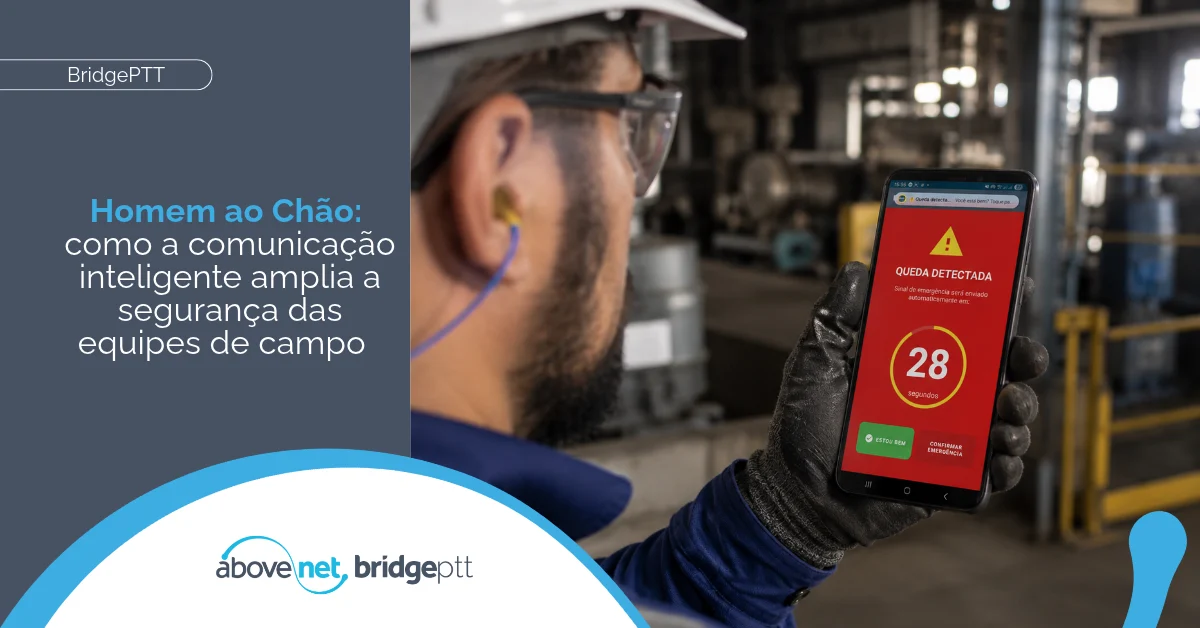
When a configured condition is recognized, BridgePTT automatically starts a countdown. This interval is important because it allows intentional movements or non-risk situations to be identified by the user before an alert is sent.
If the professional is feeling well, they can cancel the procedure during the countdown.
If the notification is not canceled within the configured period, the system interprets the lack of response as a situation that needs to be verified and automatically sends an emergency alert to the group defined by the company.
The process can be summarized in four steps:
- The device identifies a condition consistent with a possible fall.
- A countdown begins to allow the user to cancel the procedure.
- If there is no cancellation, BridgePTT automatically sends an alert to the configured group with the location, a 10-second audio clip, and channel priority.
- The control center receives the available information, assesses the incident, and coordinates the response.
This process reduces reliance on manual requests and transforms the event into a more structured response flow.
The alert reaches the team that needs to act
In an emergency, simply issuing a warning is not enough. It is necessary to ensure that the information reaches the people responsible for making decisions quickly.
In BridgePTT, the Man on the Ground alert can be sent directly to a group previously defined by the company, preventing the notification from depending on a single contact. The channel can be associated with security, supervision, operational coordination, the fire brigade, or another group established according to internal procedures.
In addition to communication on mobile devices, the solution includes a call management application accessible via computer, allowing the call center to monitor and respond to incidents in an organized manner. When an event is classified as an emergency, the call arrives on the dashboard with priority, highlighting the incident so that the responsible team can begin assessment and response more quickly.
With this, authorized professionals receive the information through the channels defined by the operation, while the dispatch center can monitor the call, evaluate the available data, and organize the initial response actions.
The definition of groups and responsibilities should reflect the operational structure of each company. Depending on the activity and level of criticality, the notification may be directed to supervisors, emergency teams, workplace safety personnel, fire brigade members, or those responsible for the location.
In this way, technology not only identifies a potential problem, but also helps to direct information to those who need to act and to organize the response from a central management point.
Location and audio help to understand the event
Receiving an alert is only the beginning of the response. To act efficiently, the call center needs to know the professional's location and gather information to help understand what may have happened.
When a Man on the Ground alert is sent, BridgePTT shares the device's available location. This information helps identify the location of the incident and direct the nearest or best-prepared team to the scene.
The control panel also receives an audio recording of the environment. Sounds from machines, alarms, movements, or even the user's own expression can contribute to an initial assessment, especially when the professional is unable to send a conventional message.
This information is available to support call analysis and decision-making by the call center. In an emergency, the combination of priority on the panel, location, and contextual information helps reduce the time needed to understand the situation and define the response.
Based on this information, the agent can use BridgePTT itself to try to establish direct contact with the professional. Communication can continue through the responsible group or be directed to an individual conversation, depending on the situation.
This contact allows confirmation of whether an emergency truly exists, verification of the user's condition, and the transmission of instructions while the support team is mobilized. Even when the alert is triggered by a non-serious situation, communication makes it possible to quickly assess the professional's condition and conclude the procedure in an organized manner.
This is a key differentiator of the solution: detection, alert, location, call management, and communication are all part of the same workflow, reducing the need to switch between different systems during an incident.
Less time between the event and the start of the response
In an emergency, every minute counts, but response time begins long before the team arrives on site.
First, it's necessary to realize that something has happened. Then, receive the alert, identify the professional's location, assess the available information, and decide who should be contacted.
When all these steps depend exclusively on the perception of third parties or a manual request, an event may remain unknown for a significant period of time.
The Man-to-Ground function helps reduce this time by automating the identification of a potentially critical condition and immediately initiating the verification workflow.
In this process, BridgePTT contributes primarily by automatically identifying a condition that may indicate a fall, forwarding the alert and available information to the responsible team, highlighting the occurrence as a priority on the management panel, and allowing direct communication with the professional.
By shortening the path between an incident and the start of a response, the company increases its ability to act quickly, with coordination and information.
From detection to response orchestration
The safety of an operation depends not only on the ability to identify a problem, but also on what happens after it is identified.
An alert that remains only on a screen or reaches a person without a defined procedure still depends on individual interpretation and decision-making. Therefore, true efficiency lies in connecting the detected event to a pre-established response flow.
In BridgePTT, the incident can be routed to the responsible group, logged in the call management application, and, in the case of an emergency, presented with priority on the control panel. The call can include location and environmental information, while direct communication with the professional remains available to complete the assessment.
From there, supervisors, workplace safety personnel, or emergency teams can follow the procedures established by the company, using the same structure to receive, analyze, and respond to the incident.
Communication therefore becomes part of orchestrating the response, helping to ensure that the right information reaches the right people, with the appropriate priority, and that the incident is handled in a faster and more standardized way.
Technology as a complement to security protocols
No technology completely eliminates the risks of an operation. The Man-on-Ground function should be used as a complement to other safety measures, such as risk analysis, proper use of protective equipment, training, supervision, preventive maintenance, and the definition of emergency procedures.
For the resource to be used efficiently, the company also needs to establish clear responsibilities. It is necessary to define who will receive the alerts, who will monitor the calls at the call center, what information should be verified, how contact with the professional will be made, and which teams should be activated in each scenario.
Periodic testing is also important to validate settings, verify connectivity, familiarize users with the countdown, and prepare dispatchers to respond appropriately to notifications.
When technology, people, and procedures work in an integrated way, security ceases to depend exclusively on an individual reaction and becomes part of a coordinated and standardized response flow.
In an emergency, every minute counts. Click to learn more about BridgePTT and discover how to enhance the protection and responsiveness of your field teams.
