
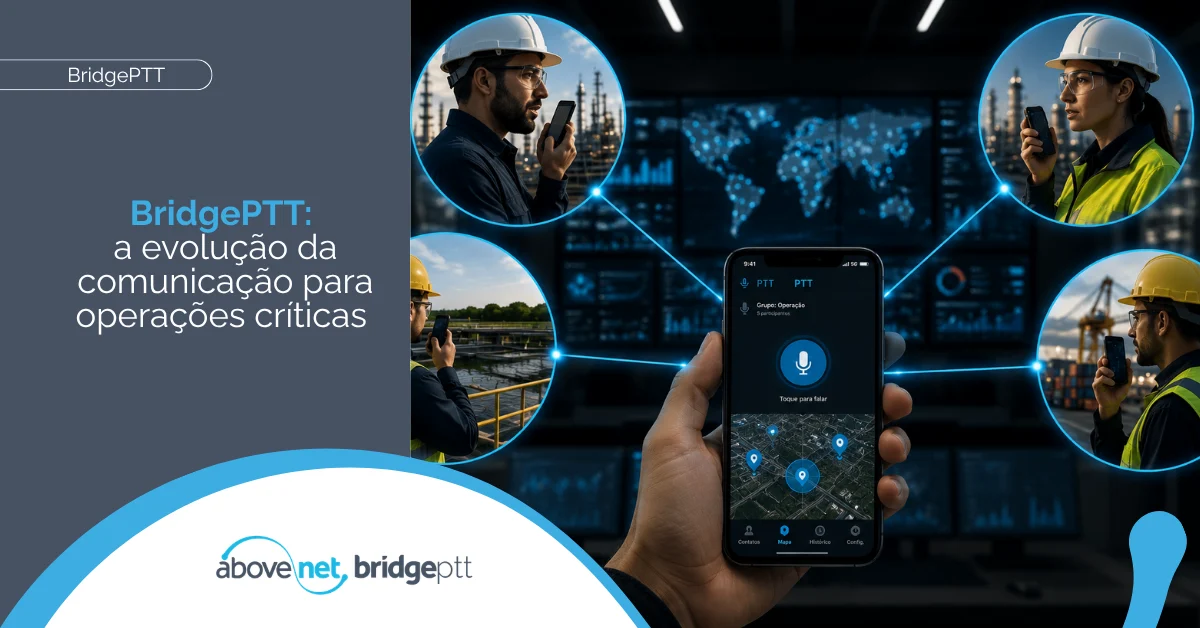
How BridgePTT transforms field communication into an active layer of security, traceability, and operational intelligence
Communication in industrial, logistics, and mission-critical environments has always been treated as a basic operational support resource. However, as teams become more distributed and operations more connected and data-driven, this approach is no longer merely limited and can represent a significant operational risk.
Today, communication needs to play a much broader role: contributing to operational safety, ensuring the traceability of events, and accelerating incident response.
This new scenario demands a change in concept: communication ceases to be merely a means of contact between people and becomes an integral part of the critical infrastructure of the operation.
The limits of the LMR when used in isolation
For decades, LMR ( Land Mobile Radio ) devices were the primary tool for keeping operational teams connected in real time. While they continue to play an important role in various environments, their isolated use may present limitations in the face of the new demands of industrial and logistics operations.
Among the main challenges are:
- Channel limitations and the possibility of congestion;
- loss or overlapping of important messages;
- poor traceability and difficulty in auditing;
- limitations in the automation of emergency events;
- Difficulty in managing devices, users, and groups;
- poor integration with digital systems used by the operation.
Furthermore, when all communications have the same priority, critical messages can get lost in the operational flow.
In environments where every second counts, communication is not enough: it is necessary to identify, prioritize, record, and act.
BridgePTT: Intelligent communication for critical environments
It is in this context that BridgePTT emerges , a solution developed by Above-Net to transform field communication into an active platform for safety and operational management.
More than just a Push-to-Talk (PTT) system, BridgePTT adds a layer of intelligence to communication, allowing voice, events, location, and operational information to be part of the same process.
Among its main features are:
- Structured and scalable communication
Unlike the conventional radio channel-based structure, BridgePTT allows you to create communication groups organized by function, area, team, operation, or criticality level.
This reduces unnecessary communication and allows each professional to receive only the information that is truly relevant to their work.
- Recording, traceability, and intelligence through AI
Communications can be recorded and used for auditing, incident investigation, and operational traceability.
With the support of Artificial Intelligence, large volumes of communication can also be analyzed and summarized, making it easier to identify relevant events and reducing the time needed to locate important information.
- Dispatch Hub and centralized management
The operations center now has a structured view of communications and events, allowing it to direct requests, prioritize critical situations, and improve coordination between field teams and dispatchers.
The objective is no longer simply "receiving calls" but rather managing operational events.
- Location integrated with communication
In addition to voice communication, the control center can visualize the location of employees and teams in the field, allowing for faster decisions, better resource allocation, and greater efficiency in responding to incidents.
- Operational safety: communication that also protects
One of BridgePTT 's main differentiators is the integration between communication and worker safety.
The Man Down functionality allows you to transform a risky situation into a structured operational event.
When a potential outage is identified, the system can automatically:
- Generate an emergency alert;
- Identify and transmit the employee's location;
- Send audio from the environment associated with the event;
- Prioritize the incident in the Dispatch Hub;
- Immediately forward the information to the team responsible for the response.
All of this can occur without relying on manual action from the employee, something particularly important in situations where they are unconscious, immobilized, or unable to call for help.
In practice, communication ceases to be merely reactive and begins to act as an active mechanism for protection and reduction of response time.
Integrated communication in operations
Another strategic advantage of BridgePTT is its ability to be part of a broader operational ecosystem.
When integrated with Bridgemeter, for example, communication and monitoring become complementary systems.
A team can receive an event related to an asset or process, identify its location and criticality, and, based on this information, immediately coordinate the people responsible for acting in the field.
This brings together two worlds that normally operate separately: machine and process data + people communication. The result is an operation with fewer silos between monitoring, events, and field teams.
Communication as a critical infrastructure
The evolution of industrial operations demands that communication be treated with a level of criticality similar to that of automation, supervision, and control systems.
It's no longer just about "talking to the team," but about: protecting people, speeding up responses, recording events, coordinating resources, and sustaining operational continuity.
Furthermore, communication itself generates information that can contribute to the continuous improvement of operations. Indicators such as response time, volume and distribution of communications, demand by area, occurrence of critical events, and operational workload of teams can help managers identify bottlenecks and optimize resources.
Communication therefore transforms from an essentially operational resource into a new source of intelligence about the operation itself.
A new standard for critical operations
In environments where a communication failure can generate operational, financial, or human impacts, using only conventional tools is no longer sufficient.
BridgePTT BridgePTT proposes a new approach by transforming communication into three elements simultaneously: communication layer, a security layer, and an operational intelligence layer. The result is not simply a team that communicates better.
It's a more connected, more traceable, more efficient, and, above all, safer operation.
