

Bridgecare enhances hospital interoperability by integrating data quality, continuous monitoring, and operational intelligence.
Digital transformation in the healthcare sector has been progressing steadily, driven by the need for operational efficiency, improved quality of care, and cost reduction. However, data fragmentation remains one of the main structural obstacles.
Beyond fragmentation, there is a second, even less explored challenge: the lack of operational control over the quality and behavior of these integrations over time. In hospital environments, it is not enough to integrate systems—it is necessary to ensure that the data is reliable, traceable, and continuously validated.
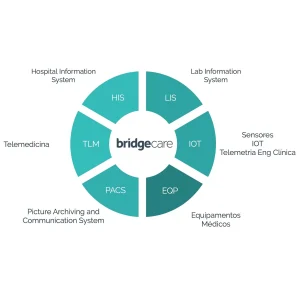
Hospitals operate with multiple systems — HIS, LIS, PACS, ERPs, and specialized platforms — that rarely share a common architecture. The result is an environment where information exists, but does not circulate with consistency, accuracy, or context.
In this context, interoperability ceases to be an isolated technological initiative and becomes a strategic discipline. However, for it to be effective, it is necessary to go beyond superficial integration between systems.
True interoperability requires three well-defined layers: syntactic, semantic, and organizational.
The syntactic layer resolves the format of data exchange, using standards such as HL7, FHIR, and DICOM. The semantic layer ensures that the meaning of the information is preserved between different systems. Finally, the organizational layer establishes rules for governance, control, and use of the data.
This is precisely where most initiatives fail. Integration happens, but without quality control, traceability, or standardization. This is where Bridgecare positions itself as a structuring layer of the operation.
Unlike traditional approaches, Bridgecare doesn't just act as middleware or an integration bus. It operates as an interoperability management platform, combining a central repository, data quality engines, integration intelligence, and continuous operational monitoring.
This approach allows for the consolidation of information from multiple systems and its availability in a standardized, auditable, and governed manner, replacing fragmented architectures with a single, scalable, and controlled model.
Data quality as a central element
Interoperability, when not accompanied by control mechanisms, tends to amplify inconsistencies. Bridgecare incorporates specific services to address this problem, including:
- Database cleansing
- Identifying duplicates and homonyms
- Validation of records with external databases (Cognimatch)
- Automatic or assisted correction of inconsistencies
This approach transforms raw data into a reliable asset, allowing the construction of a critical concept: "gold" data.
By validating information such as CPF (Brazilian taxpayer ID), name, date of birth, and clinical affiliations, the system drastically reduces registration errors and healthcare risks.
This process is supported by specialized services such as Cognimatch, which performs validation with external databases and consolidates reliable records, creating a single, consistent database for the entire hospital operation.
Operational governance of integration
Another structural point lies in the governance of integrations. In complex environments, integration alone is not enough; it is necessary to ensure that the integration functions continuously and with quality.
Bridgecare introduces a concept that is still relatively unexplored in the industry: integration monitoring intelligence.
Each integrated system receives a quality score based on consistency, configuration, and data behavior, called the integration IQ (Cognilink), which allows:
- Proactive identification of integration failures
- Quick diagnosis of inconsistencies
- Complete audit of records and transformations
Interoperability is no longer a "black box" and is becoming measurable.
This model transforms integration into an active and managed process, where each system ceases to be merely a connection point and is continuously evaluated for its quality, stability, and operational reliability.
Another major challenge for hospital networks is scaling without increasing complexity. Bridgecare solves this with a modular architecture based on connectors, where each component is responsible for receiving, transforming, and distributing data according to the context.
This structure allows:
- Progressive integration of legacy systems
- Adapting to the digital maturity of each institution
- Expansion to multiple units without complete restructuring
Furthermore, support for a wide range of protocols (HL7, FHIR, JSON, XML, MQTT, among others) ensures true interoperability in heterogeneous environments.
Extended integration: systems, equipment and infrastructure
Bridgecare but also the hospital's physical infrastructure.
Medical equipment, IoT sensors, medical gas systems, energy, water, and climate control are now monitored within the same platform, creating a unified view of clinical and operational performance.
This convergence eliminates silos between healthcare areas, clinical engineering, and building operations, allowing for integrated management of the entire hospital environment.
Security and access control
Data governance in healthcare is directly linked to security. Therefore, Bridgecare incorporates robust mechanisms such as:
- Single Sign-On (SSO) with OAuth2
- Granular control of permissions by profile
- AES256 and SSL/TLS encryption
- Complete audit of access and operations
These mechanisms allow interoperability to occur within an auditable, secure environment that adheres to regulatory requirements, without compromising the scalability of the operation.
Operational intelligence and predictive maintenance
Through integration with sensors and equipment, Bridgecare enables an additional layer of value: operational intelligence.
The platform identifies equipment degradation, behavioral anomalies, and operational patterns that indicate impending failures.
Furthermore, it allows for the creation of automated maintenance workflows, the execution of dynamic checklists in the field, and the targeting of corrective actions in real time.
This approach reduces operational costs, increases asset availability, and improves the safety of hospital operations by transforming data into actionable steps.
Scale, performance and reliability
Interoperability in healthcare cannot be treated as a simple integration between systems. It requires architecture, governance, control, and intelligence. Bridgecare acts precisely in this area: as a layer that not only connects but also organizes, qualifies, and operationalizes the use of data.
With a robust, scalable architecture based on consolidated experience in critical environments, the platform already operates at scale, processing millions of records and ensuring high availability and reliability.
By integrating clinical systems, equipment, and infrastructure into a single platform, ensuring quality, traceability, and data intelligence, Bridgecare transforms interoperability into a central element of hospital operations.
More than just connecting systems, it enables faster decision-making, risk reduction, operational efficiency, and predictability at scale.
In the current scenario, where efficiency and safety are paramount, this convergence ceases to be a differentiating factor and becomes an essential condition for operation.
