
Industry is a fundamental sector for the functioning of a country's economic engine. The more industrialized a country is, the greater the benefits for society, from quality of life to job creation.
Currently, the industrial ecosystem is driven by the constant need for modernization and increased efficiency to reduce production costs. Optimizing production processes is a challenge that depends on integrated and automated infrastructure collaboration. To achieve this, companies need an interoperable solution capable of collecting data from various equipment, storing it in a structured way, processing it to create a real-time decision flow, and making it available to other systems passively or even proactively.
The IIoT solves a number of problems through monitoring, reducing operational maintenance costs because it can alert to deviations from standards in any operation. However, the process is still flawed if we receive an alarm about an engine that is nearing maintenance when there is no communication with the system that controls inventory and indicates a zero quantity of that replacement part.
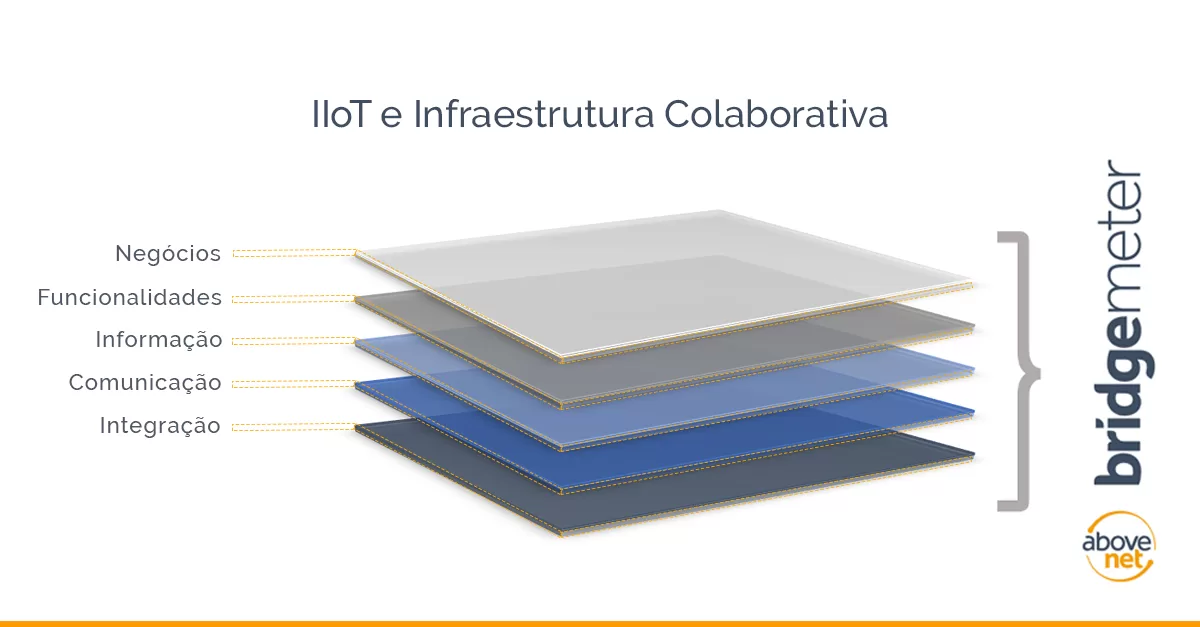
As expected, a solution involving collaborative infrastructure depends on the integration of equipment and systems across multiple layers that need to be integrated to create the desired solution:
- The first layer, at the equipment end, is called the integration (physical) layer, responsible for connecting and transmitting information from assets that do not always have the same level of maturity in the plant. In other words, these may be equipment with analog sensor interfaces (e.g., 4-20mA), digital ports, controllers (PLCs), or even "smart sensors," which hinder the uniform connection of all this infrastructure in a decentralized manner. This layer involves the research and purchase of communication equipment with various interfaces for connection to the desired assets, requiring significant investments in rapidly evolving technological assets.
- The second layer, the communication layer, requires the conversion of communication protocols that vary according to each application asset, and for this, the solution must allow the reading of any protocol. Additional development is necessary for each type of protocol and desired conversion.
- The third layer, the information layer, is responsible for storing information in a structured and industry-certified format. This information is then available for use by other specialized tools and systems. Additional development is needed at this layer to ensure that the information is in a standardized and industry-approved format.
- The fourth layer, focused on functionality, reflects the need for real-time management and processing of this information to generate predictive alarms and notifications. It's necessary to build an interface and intelligent system that allows for easy and reliable management of this service, capable of processing notifications securely.
- Finally, the fifth layer is the business layer responsible for interoperability with operational management, maintenance, and customer relationship systems, generating process triggers necessary for the complete automation of the process.
Most IIoT projects are slow and often never get off the ground because they depend on the internal development of all these layers within the company, and consequently, a high labor cost.
In addition to developing systems with programmers, it is necessary to integrate various tools from different vendors to assemble a model that is highly specific to the solution, even in a semi-automatic way. The result is almost always a "Frankenstein" with little flexibility and a high cost of ownership.
Bridgemeter was created to meet precisely this demand for collaborative infrastructure, integrating the 5 layers in a true digitization process (not to be confused with digitalization), in a turnkey model that eliminates the need for development, programming team expenses, and internal development time outside the company's core business focus.
The goal is to implement, without any CAPEX cost and in a very short timeframe, a solution that offers fully automated information gathering, alerts, notifications, triggers, and auditing, with operational and maintenance benefits based on a solution-as-a-service model.
