The digital age is reshaping every aspect of our lives, and the healthcare sector is no exception. Digital Transformation in Healthcare represents a paradigm shift in how we conceive, deliver, and manage medical care. This revolution goes far beyond the mere adoption of new technologies; it is a complete reinvention of care models, workflows, and the relationship between patients and healthcare providers.
From the implementation of Electronic Health Records (EHR) to the use of Artificial Intelligence for diagnoses, and including telemedicine and IoT devices for continuous monitoring, digital transformation is redefining the possibilities in the field of healthcare. This evolution promises more personalized, efficient, and accessible care.
This article addresses the crucial importance of digital transformation in healthcare, the interoperability challenges it presents, and how innovative solutions are redefining the future of healthcare systems integration. We explore the complexities of the current landscape and present a vision of a future where technology not only facilitates but enhances patient-centered care.
The Importance of Digital Transformation in Healthcare
The urgency of this transformation is undeniable. In a world where the demand for healthcare services is growing exponentially, digitalization offers solutions to critical challenges. The single patient record and increased safety in treatment are a reality and require the integration of historical data into a single record. Operational efficiency increases significantly, freeing healthcare professionals from administrative tasks so they can focus on what really matters: direct patient care.
Furthermore, digital transformation catalyzes medical research and innovation. The structuring and access to large volumes of integrated data facilitates studies and accelerates the development of new treatments. In both the context of large hospital networks and public health, the ability to unify care and analyze data on a large scale transforms policy planning and the response to health emergencies.
Some of the most significant benefits include:
- Single Patient Record : Integrating patient data regardless of the care setting offers security and efficiency for the patient.
- Reducing multiple data collection: With integrated, unified information, data entry and bureaucratic activities are reduced, allowing for a focus on the patient.
- Accelerating medical research and innovation : Access to large volumes of structured and integrated data drives the development of new treatments.
- Improvements in public health : Large-scale data analysis is revolutionizing policy planning and response to health emergencies.
- Patient empowerment : Easy and secure access to their own health information, along with integrated appointment scheduling, vaccinations, and telemedicine services, allows for faster scheduling and quicker treatment decisions.
The challenges that digital transformation in healthcare poses for interoperability between healthcare systems
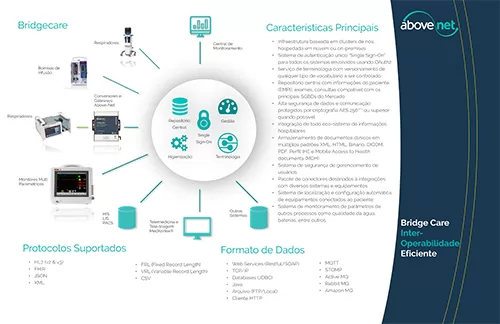
In the context of digital transformation in healthcare, the efficient integration of information between different systems is a monumental challenge. In any hospital, we can find an electronic health record, also known as a Hospital Information System (HIS), laboratory systems or Laboratory Information Systems (LIS), and imaging systems, known as Picture Archiving and Communication Systems (PACS). Other equally important systems, such as telemedicine and even IoT devices for telemetry, are also part of this integration challenge. Despite industry attempts to standardize communication, different communication and storage protocols exist for each, leading to conflicts and incompatibilities.
This digital babel results in a series of critical problems:
- Infeasibility of Integrations: With so many variables and terminologies, it is impossible to manage an integration architecture without a dedicated system or platform.
- Inconsistent data : A patient may have conflicting information across different systems, compromising the quality and safety of care.
- Misconduct : Incomplete or incorrect information can lead to flawed clinical decisions.
- Constant rework : Healthcare professionals waste precious time entering the same information into multiple systems.
- High costs : Lack of interoperability generates operational inefficiencies that inflate healthcare costs.
- Patient frustration and insecurity : The need to repeat information at each appointment harms the patient experience.
- Difficulty in managing private and public health networks : Companies and government agencies face obstacles in consolidating data and making evidence-based decisions.
How to solve the complex challenge of interoperability between health systems?
The solution to this intricate problem requires a multifaceted and intelligent approach. Imagine a central platform capable of acting as a universal translator between systems, detecting inconsistencies in integrations and errors in transmitted data in real time. This ideal platform would apply complex business rules to ensure the integrity and quality of information, offering complete visibility over the data flow.
More than that, such a solution would generate actionable insights to continuously improve data quality and process efficiency. By dynamically highlighting changes in integrated systems, it would eliminate the need for constant manual interventions. Intuitive dashboards would allow managers to monitor the health of data integration in real time, anticipating and resolving problems before they impact patient care.
This approach would not only solve current problems, but also establish a solid foundation for the continuous evolution of healthcare systems, preparing them for the future challenges of digital medicine.
Bridgecare and its new feature, Cognilink, are transforming the reality of interoperability in healthcare
Bridgecare , robust healthcare interoperability solution:
- Manages data for over 27 million patients
- It processed more than 380 million customer service requests
- It stores more than 185 million test results
- It recorded more than 190 million medication dispensations
- It tracks more than 30 million prenatal and pregnancy exams
With an impressive 99.9999% availability, Bridgecare demonstrates its reliability in an industry where every second counts.
It is in this context that Bridgecare, which already has the largest patient database in Latin America and one of the largest in the world in a single system, presents its latest innovation: Cognilink.
Cognilink is the natural evolution of this platform, bringing artificial intelligence to the heart of healthcare interoperability. Its main features include:
- Real-Time Alarm Panel : Monitors and alerts you to integration problems over the past 24 hours, allowing for immediate action.
- Intelligent Error Detection : Automatically identifies and categorizes inconsistencies in data loads, from missing required fields to outdated information.
- Integration Quality Score (IQ) : Assigns a score to each integrated system, encouraging continuous improvement in data quality.
- Predictive Analytics : Uses historical patterns to anticipate potential problems before they affect operations.
- Customizable Dashboards : Allows managers to view crucial metrics and make informed decisions quickly.
- Task Automation : Creates automated workflows for error correction, reducing the need for manual intervention.
- Complete Traceability : Maintains a detailed record of all transactions, from shipment to any eventual dispute, and offers an intelligent search system facilitating audits and regulatory compliance.
Bridgecare Cognilink is not just a tool, it's an intelligence ally that is constantly evolving.
For private institutions and public health systems, Cognilink means:
- Drastic reduction in integration problem resolution time
- Significant improvement in the quality of clinical data
- Increased reliability of information for decision-making
- Optimizing IT resources, freeing up teams for strategic projects
- Simplified compliance with data protection regulations
Conclusion
In a scenario where the digital transformation of healthcare is imperative, Cognilink positions itself as a fundamental piece. It not only solves current interoperability challenges, but also prepares institutions for a future where continuous data integration will be the norm, not the exception.
By adopting Bridgecare with its new AI feature, Cognilink, healthcare organizations are taking a decisive step toward a truly connected, efficient, and patient-centered healthcare ecosystem. It's more than a technology solution; it's a catalyst for a revolution in the quality of healthcare.
Want to learn more about how Bridgecare, with its AI, Cognilink, can transform interoperability in your private institution or public healthcare system?
Download our complete catalog now and discover how we can help you meet the challenges of digital transformation and systems interoperability in healthcare.